

I.M. a Resident/Fellow: John Stevenson, DO, MPH
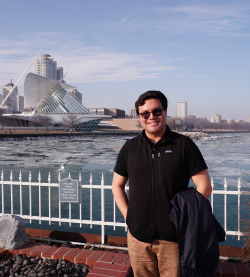
John Stevenson, DO, MPH
Internal Medicine Residency
Aurora Health Care
Milwaukee, WI
In which residency or fellowship program are you currently in?
I am a third-year internal medicine resident (PGY-3) at Aurora Health Care in Milwaukee, Wisconsin.
Why did you choose internal medicine? If you’re in fellowship, why did you choose that subspecialty?
Internal medicine appealed to me because it refuses to narrow too early. Every admission begins with a question rather than an answer, and the field rewards physicians willing to sit with uncertainty, gather the whole picture, and think before acting. Over the course of residency, I have noticed that the cases holding my attention longest nearly all involved the liver and the gastrointestinal (GI) tract, and that pull has stayed consistent across the wards, the clinic, and my scholarly work. For me, pursuing gastroenterology is not a change of direction; it is internal medicine carried further. The habits the field has taught me—thoroughness, humility, and thinking in years rather than hospital days—are exactly what I want to bring into a subspecialty built on lasting patient relationships.
What lesson(s) did you learn in residency or fellowship that will help you for the rest of your career?
Three lessons stand out. First, good medicine is a team effort: nurses, pharmacists, and consultants have caught things I missed; and asking for help early is a strength not a weakness. Second, follow-through matters more than brilliance; a thoughtful plan means little if the order is never placed or the result never chased. Third, residents sit closer to the day-to-day friction of a hospital than almost anyone, which makes us well positioned to help fix it. Serving as Senior Co-Chair of our Resident Council has shown me that institutions genuinely want trainee input when it arrives organized, specific, and paired with a proposed solution. I expect to carry all three lessons for the rest of my career.
What are your plans for after residency or fellowship? What factors or advice from mentors contributed to your decision?
After residency, I hope to train in gastroenterology, and I am applying to fellowship programs this cycle. The seed was planted in medical school on a GI elective in Huntsville, Alabama, where my attending, Dr. Bradley Rice, generously showed me the full breadth of the specialty—from clinic to the endoscopy suite—and the fit was immediate. My mentors in residency have reinforced the decision mostly by example: watching gastroenterology faculty balance procedural work with real continuity of care, and research with teaching, showed me the kind of career I want to build. The advice that has stayed with me most is simple: whatever you go on to do, be the kind of internal medicine physician you would trust with the care of your own family and loved ones.
How has being a member of ACP helped you in your professional life? What resources have been most helpful to you?
ACP has been a steady home for my scholarly work. I have presented clinical case posters at the Wisconsin Chapter’s annual scientific meeting in each of the past two years, most recently adding an oral presentation this fall. The relationships I have built through the Chapter, with residents and faculty well beyond my own hospital, have been the most valuable resource of all, and publications like IMpower help keep that